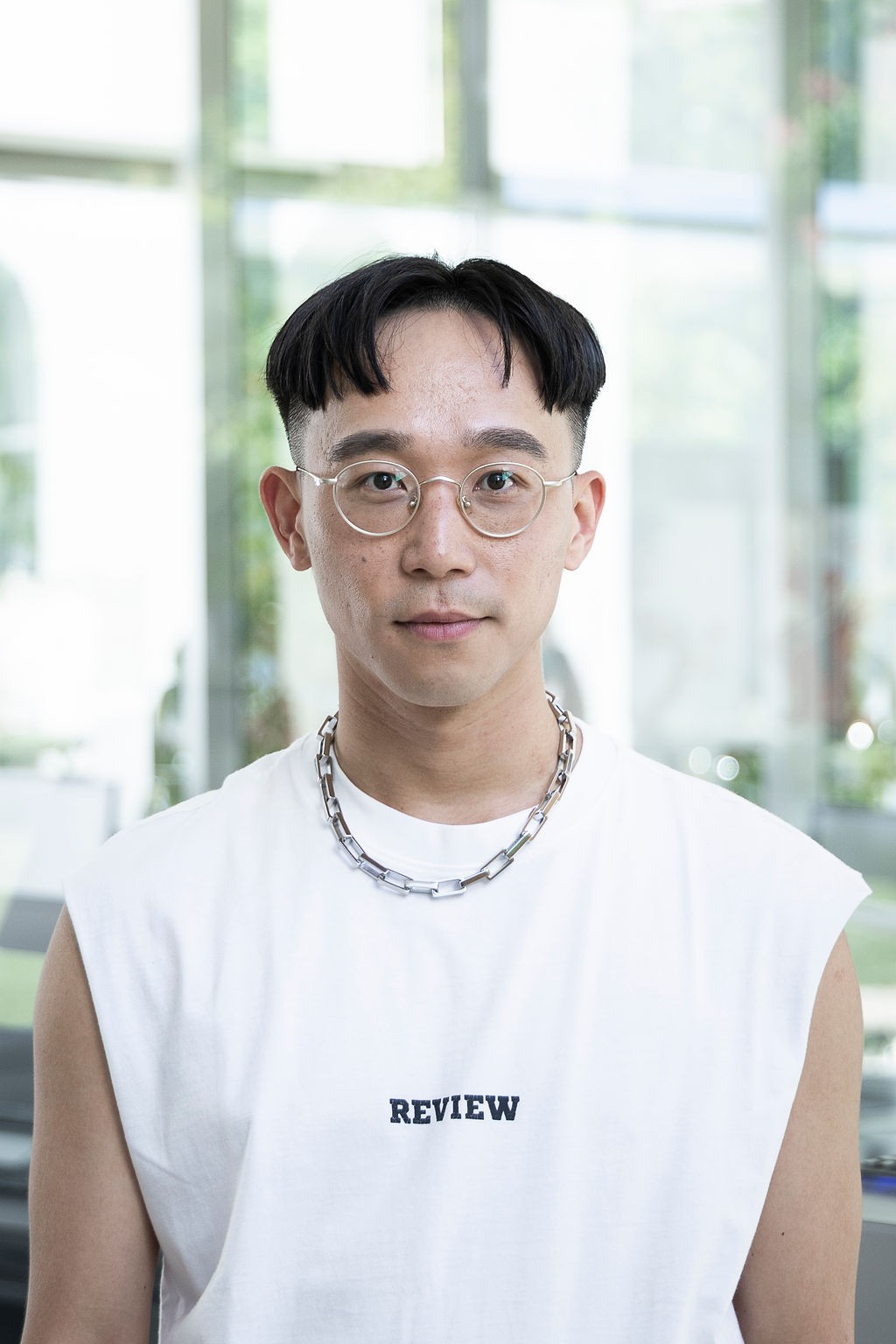
Ting-Chia Wu is a visual artist and cultural researcher, currently based in Vienna and Berlin. His work examines the politics of images and the production of meaning circulating within their material, historical, social, and ecological conditions. Based in media and critical theory, Ting-Chia Wu investigates how the real and the imaginary converge in a hypermediated world through writing, performance, and moving images.
He holds a BA in Fine Arts from the National Taiwan University of Arts, an MFA (DNSEP) from École supérieure d’art et design Le Havre-Rouen, and an MA in the Ecology of Arts and Media from the University of Paris VIII. From 2023-25, he served as a research assistant at the Forum Internationale Wissenschaft Bonn — Abteilung Digitale Gesellschaft (Digital Society) at the University of Bonn. He is currently a doctoral researcher in the Structured Doctoral Program “Performing Matters: Manifold Temporalities” at the University of Music and Performing Arts Vienna.
Situated within media, postcolonial studies, and critical theory, this research explores how media art represents, performs, and mediates Taiwanese cultural identity in both postcolonial and post-cinematic contexts. Without a clear rupture, postcoloniality and the post-cinematic mark a continuation and transformation of the past, which continues to affect the present. In the 21st century, networked technologies, alongside the neoliberal economy, shape contemporary lived experience, including hypermediacy, timeless time, and the space of flows. Focusing on Taiwan, given its ambiguous, or even unrecognised, status regarding national autonomy and its unsettled historical, cultural, and geopolitical entanglements, this research will approach Taiwanese cultural identity as a lived experience in terms of intertwined temporalities, divergent historicisms, and cultural hybridity within technoscientific, political-economic infrastructure. Given the ambiguity of modern nation-state discourse, the plasticity of cultural imagination, and the controversy over postcolonial cultural hybridity and visibility, Taiwanese cultural identity depends heavily on artistic mediation and representation.
It is no coincidence that the so-called “modernisation” of the island began with Japanese colonial rule, which developed in parallel with the first public screening of cinema in Paris in 1895. Thereafter, cinematic and media representations have accompanied Taiwan’s history, memory, and the construction of identity, from Japanese colonialism and Chinese nationalist autocracy to American-led neoliberalism and the present day, when images circulate rapidly in digital culture. Hence, this research aims, on the one hand, to examine how such lived and felt experience of a postcolonial cultural identity — cultural hybridity in becoming — can be articulated and performed through media art; on the other hand, to explore how media art engages with the transformative potential of cultural identity within the “play” of histories, imaginations, fantasies, myths, narratives, time, and images in circulation.