Prague Calling …
This year’s Dancecult Research Network conference (DC26) took place from 14 to 15 May 2026 in Prague and focused on “Heritage, Memory and Community in Electronic Music and Dance Cultures” (EDMC for short), drawing scholarly attention to “who defines and holds cultural memory … and what terminologies, narratives, and inequalities shape the way we understand these cultures today.” This is a perfect match to my research interest to begin with, promising insights on up-to-date research concerning my music-sociological and queer theory-related PhD project on historiography and the construction of cultural heritage of house and techno music. Dedicated research conferences truly are very rare, so I made sure not to miss this opportunity.
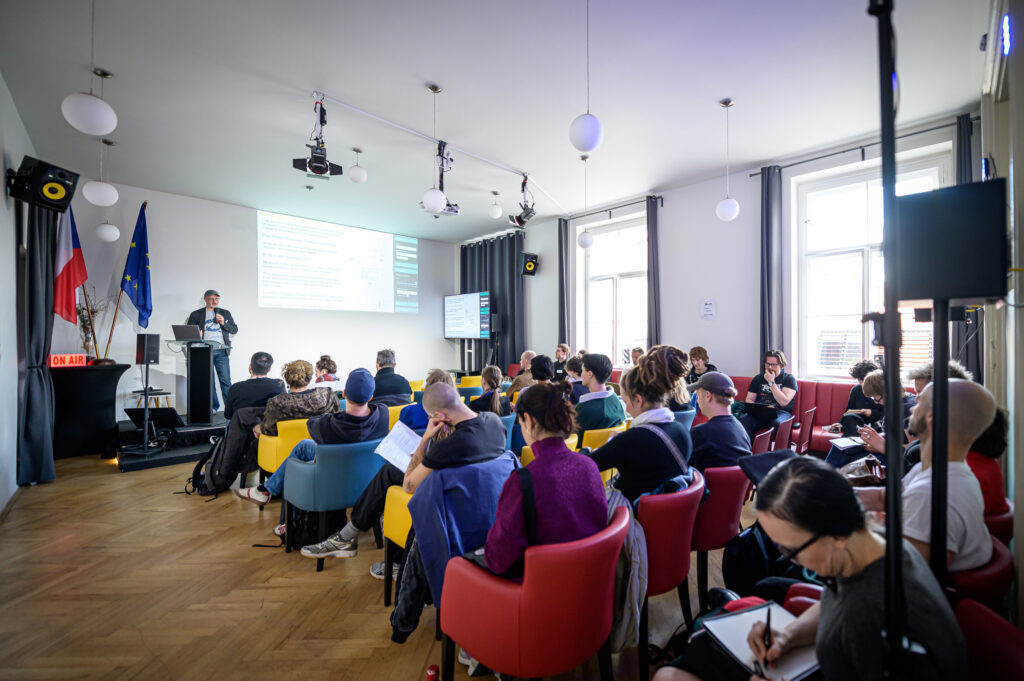
The organisers—Ondřej Daniel and his team at the Faculty of Arts of Charles University, along with the Dancecult journal and research network—called for presentations addressing “how these cultures remember, preserve, share and adapt—not only as musical and nightlife practices, but also as deeply embedded social and spatial experiences.” I was thrilled to represent the mdw and its Department of Music Sociology with a presentation on my ongoing research, and time flew by until I arrived just in time for the pre-conference get-together.
Conference Highlights
Over the course of the two-day conference, I attended presentations on the themes of “Heritage, Memory and Community”, “Terminologies and Language”, and “New Inequalities”, focusing on the question: How did the conference’s central theme expand upon that, and which presentations highlighted key topics relevant to my research?
Ondřej Daniel kicked off DC26 by introducing the faculty and the Centre for the Study of Popular Culture (CSPK) in Prague, concluding with a chilling account of this year’s May 1st rally ending in far-right attacks on the Centre itself. Echoing memories of the political resistance in Tbilisi and in tune with the recent governmental change in Hungary, Dorottya Herbály gave a gripping account of the repression by Hungary’s former administration of Budapest’s club culture and the community response, proving once again that dance music extends beyond mere entertainment. In his presentation, Lorenzo Montefinese attributed the growing scholarly interest in popular-music heritage and musical-cultural memory to today’s situation, in which clubs are shutting down due to post-pandemic economic struggles and a general lack of spaces in urban centres, rendering it increasingly more difficult to actually do it and live it as it used to be. Continuing on the contentification of culture, Timo Koren expanded on Berlinocentric accounts of Germany’s club culture historicisation, calling for a multidimensional narrativisation in lieu of prevailing simplified “Hollywood versions”, opening the discussion to the hybridity of heritage and symbolic justice.
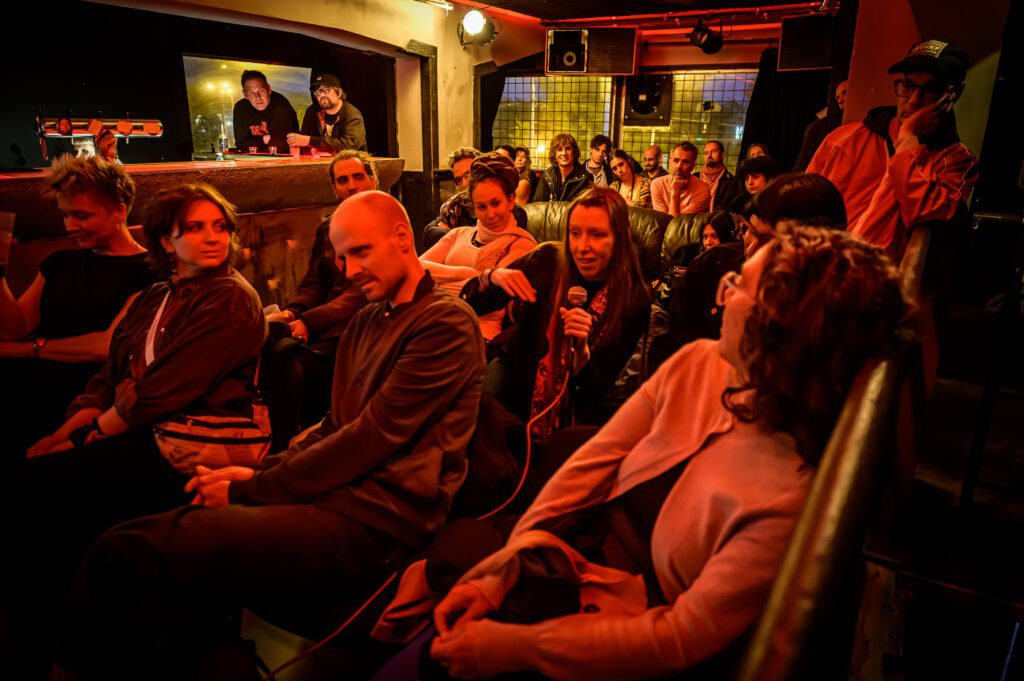
Nancy Aumais turned the conference’s attention to gendered blind spots in the night studies, in which androcentric epistemic legacies mask gendered inequalities and epistemic injustice. She argued that the night itself should be recognised as a “political space-time where power relations, tensions, and forms of resistance take shape”. By asking whose experiences are recognised and whose knowledge counts, Aumais pointed out clearly that feminist perspectives still remain marginal today. Encouraging the audience to deepen feminist and queer networks, she concluded with a call for more direct engagement among EDMC studies’ scholars and academics. Following this call, David Aaron Swartz impressively presented his Queer Club Culture Archive project on the topics of archiving dominion and the fact of queer club culture erasure. Resonating with my own research experience, Swartz emphasised the erasure of queer cultural achievements and contributions, happening through the limitation of their visibility or by the suppression of “the lived experience of marginalised people in the historical record” (Swartz)—not only on the scale of national politics, cultural heritage, and governmental discrimination, but also in terms of digital censorship. As a grassroots initiative, his project aims to bridge club culture entrepreneurship and scholarship: “built by queers and for queers” (Swartz), to foster visibility and representation by means of institutionalised, collaborative archival work.
Carla Vecchiola contributed with a perspective from within Detroit (a much revered and mystified place on the map of electronic dance music) about what tourism does to a place over time. While tourists are often drawn to touch the musical origins of genres, legendary record labels, and musicians/producers, the locals are keen to protect their scene. As Vecchiola showed, the electronic dance music’s industry structure exploited the city’s cultural capital by featuring and booking Detroit artists, yet at the same time created an imbalance in Detroit’s music scene by omitting its promoters. Finally, a promising early-stage infrastructural approach to connect archiving and grassroots initiatives was presented by Matthias Pasdzierny—at this stage, to act as a sustainably funded and institutionally hosted club cultural heritage network and architecture in the broadest sense.
Contribution
My presentation “On The Analysis of German Club Culture TV Documentaries: Confirming/Contesting Hegemony in Club Culture Historiography and Heritagisation?” took place later on the first day of the conference, in the panel dedicated to “Politics, Visibility & Media Historiography”. Starting with historical context and today’s panorama of club culture historicisation, I provided a brief music-sociological interpretation of statistical analyses of two popular German club-culture TV documentaries, as well as disclosing some of the industrial and organisational structures responsible for their production. Although there clearly has been some progress made in terms of diversity and visibility, female*, queer and of Colour representations mostly address problematic issues, if not entirely excluded, while cis and hetero protagonists carry on gaining their laurels unquestioned. Seconding Rosa Reitsamer’s analysis[1] of female (likewise queer and of Colour) musicians (and cultural workers) being significantly underrepresented in discourses on popular music history and heritage, a research perspective in line with this is therefore more than appropriate. This, too, confirms once again the research gap and need for exploring the semantic dimension of club culture historiography in my PhD research—because the historical origins of club culture tell a story rich in contributions outside the heteronormative narratives of marketable pioneers, and because female* contributions to pioneering electronic music remain largely untold.
Conclusion
As I reviewed my conference memos for writing this report, the links between aforementioned presentations and my research became evident. In times like ours, DC26 and its theme of “Heritage, Memory and Community in Electronic Music and Dance Cultures” underlined the urgency of queer and feminist scholarship: The repression in electronic dance music and club culture is repeated at the very moment their historiography is being written. Just as music relates to the culture in which it is produced, so does the historiography to the times in which it is being narrativised, or as Tim Wall suggested, fabricated.[2]
To my observation, the presentations at the conference made clear that inequalities in terms of race, gender and class effectively prevail despite being continuously challenged. In light of DC26’s announcement that “terminologies, narratives … shape the way we understand these cultures today”, to observe the term techno being associated with electronic dance music beyond genre descriptions especially in German research projects, raises a few questions to be discussed. Similarly, the hegemony of Berlinocentric discourse—as a pars pro toto phenomena in both platform journalism and the research community—was reified by a dedicated conference track. Having said that, a critical examination is needed to improve research agendas as well as the resulting outcome: Who remains in the cultural memory, who prevails there, who represents the cultural heritage, and, last but not least, where else is this located discursively and appropriately?
Having been able to attend the conference as an early career researcher, and to actively and critically contribute to the research community, making useful contacts to networks and individuals there, was of tremendous value. To that end, I am deeply grateful for the generous funding by mdw’s Research Support Office, and to have had the chance to represent the mdw and its Department of Music Sociology at the DC26 Dancecult Research Network conference in Prague.
[1] Rosa Reitsamer, “Gendered narratives of popular music history and heritage”, in Sarah Baker et al. (eds), The Routledge Companion to Popular Music History and Heritage (Routledge, 2020), 26-35.
[2] See Tim Wall, Studying Popular Music Culture, 2nd ed. (Sage, 2013).
Photo credits: Petr Zewlakk Vrabec, Pia Raddatz