Athens Deleuze and Guattari Conference from the Heart …
This year’s 18th Deleuze and Guattari Studies International Conference took place from 10 to 12 July 2026 at Panteion University of Social and Political Sciences in Athens. Under the title Transversality: Ethics and Politics, the conference brought together researchers, philosophers, and artists to consider transversality as a movement that crosses established boundaries, creates relations, and unsettles dominant ways of thinking. Through lectures, discussions, workshops, and performances, the programme explored how transversal thinking can inform philosophy, art, politics, pedagogy, and collective practice today.
This was a perfect match for my own research interests, which lie at the intersection of Deleuze and Foucault studies, film philosophy, artistic research, and performance philosophy. It also provided an ideal international context in which to represent the mdw and the FWF-PEEK research project Philosophy in the Arts : Arts in Philosophy. Cross-Cultural Research on the Significance of the Heart in Artistic Research and Performance Philosophy. The project is based at the Artistic Research Center of the mdw and investigates the significance of the heart for artistic research and performance philosophy from a cross-cultural perspective. It is funded by the Austrian Science Fund FWF under Grant DOI 10.55776/AR822.
Dedicated conferences at which philosophical concepts are discussed alongside cinematic, performative, and artistic practices are still relatively rare. I was therefore thrilled to have the opportunity to participate in this international research community, to present our current work, and to introduce some of the methodological questions developed within the HEART project to researchers working on Deleuze and Guattari from a wide range of disciplinary and geographical perspectives.
Conference Highlights
Over the course of the three-day conference, the concept of transversality was approached from philosophical, political, psychoanalytic, technological, and artistic perspectives. The programme included keynote lectures by Ian Buchanan, Charles J. Stivale, Andrew Culp, Eric Alliez, Dorothea Olkowski, and Anne Querrien, addressing topics ranging from assemblages, algorithms, and archives to transversal politics, creation, and collective practice.
Already the conference programme suggested that transversality should not be treated merely as another object of philosophical interpretation. Rather, it became a question of how thought itself travels: between disciplines, between artistic and theoretical practices, between institutions and political movements, and between different forms of expression. The conference’s combination of theoretical presentations, workshops, lecture performances, sound-art events, and a film programme created a productive framework for considering philosophy as something that can be articulated not only through concepts and texts, but also through images, sounds, movements, spatial arrangements, and collective situations.
Andrew Culp’s lecture “Post-Deleuzianism: Thought without Cliché” similarly addressed the difficulty of working with Deleuze without reducing his concepts to recognisable formulas or established academic gestures. Eric Alliez’s keynote “Transversality and Politics” placed the philosophical concept within the wider political stakes of the conference. Across the parallel sessions, these questions were expanded through contributions on cinema, digital technologies, archives, artificial intelligence, sound, architecture, ecology, feminism, queer theory, and institutional practice. What connected many of these presentations was an understanding of transversality as an operation: a cut across already constituted fields that does not simply bring separate disciplines together but alters the relations between them. This strongly resonated with the HEART project. Its research formats, art labs, field performances, a notebook, a mobile Heart Lab, and the research festival Philosophy on Stage are based on the assumption that artistic and philosophical practices can transform one another when their respective methods and forms of knowledge are brought into a shared research situation. The project stages encounters between philosophy, the arts, cardiology, physics, South Asian studies, and other fields, asking what kind of thought becomes possible when research is organised through such transversal relations.
Contribution
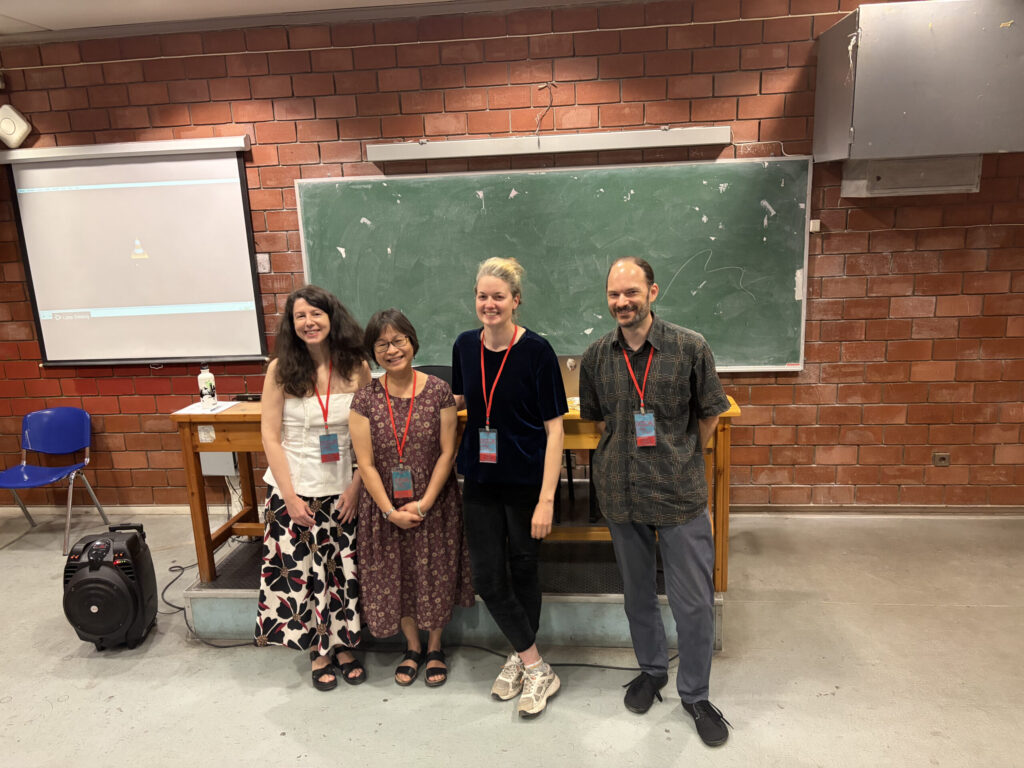
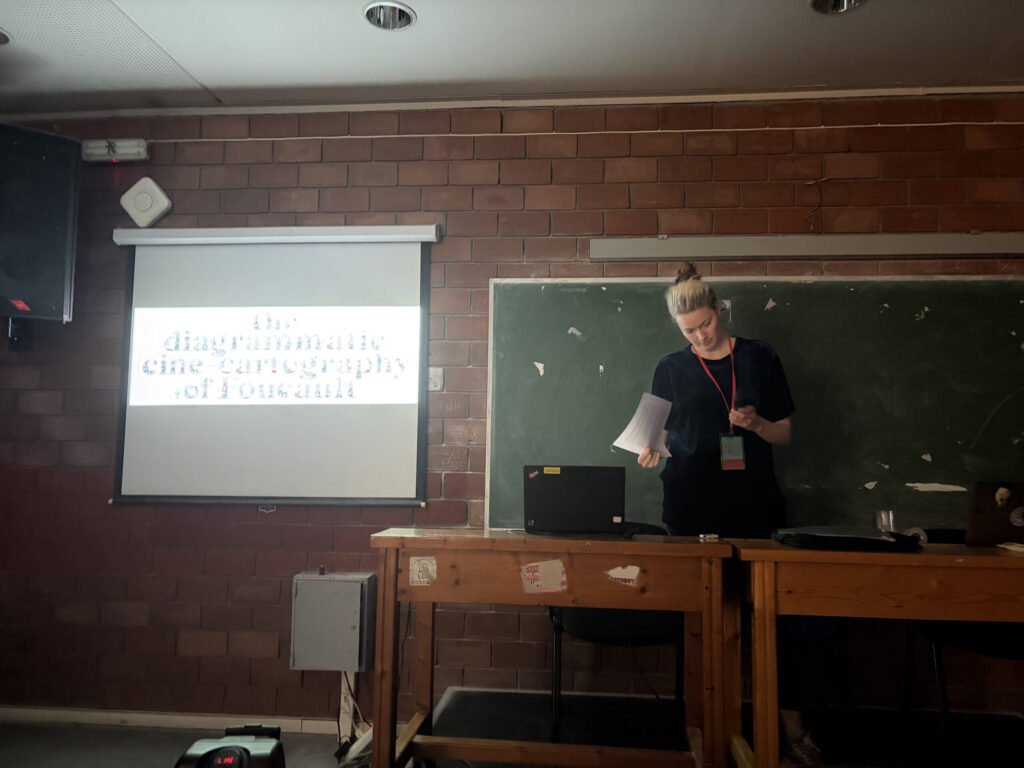
My presentation took place on the first day of the conference in the panel “Transversal Cinematography, Lines of Flight, Recomposition and the Cut”. The session also included contributions by Andreas Hudelist on Jonas Carpignano’s films as practices of resistance and collective subjectification, Maria Sanida on Pasolini’s Teorema, and Yifen Beus on fragmentation and female voices in Oceanian filmmaking.
My contribution asked how Deleuze’s reading of Foucault might be translated into a cinematographic practice. Rather than producing a film that merely explains or illustrates Foucault’s philosophy, my research explores how philosophical relations can themselves become cinematic operations informed by the HEART research project: images, voices, sounds, intervals, superimpositions, movements, and cuts.
At the centre of the presentation was the question of how Foucault’s distinction between the visible and the sayable can be approached audiovisually. In Deleuze’s reading, the visible and the sayable form two irreducible strata. They do not simply correspond to image and language, nor can one be understood as a representation of the other. A cinematographic cartography of Foucault must therefore avoid subordinating images to a spoken commentary or using language merely to explain what is already visible. Instead, it has to construct relations, gaps and disjunctions between heterogeneous audiovisual materials.
The transversal cut became a way of describing this operation. A cinematic cut separates images and sounds, but at the same time establishes new relations between them. It can traverse different historical layers, discourses, institutions, and forms of visibility without reducing them to a unified narrative. In this sense, cinematography becomes a form of cartography: It follows lines, forces and transformations rather than representing a stable philosophical system.
Presenting this research at a conference devoted to transversality allowed us to place the project in dialogue with current work in Deleuze and Guattari studies. The panel made especially clear that cinema can be understood not only as an object of philosophical analysis, but as a mode of thinking and research in its own right. Cinematic operations do not simply communicate concepts produced elsewhere. They participate in the production and transformation of concepts.
Representing the HEART Project
In addition to presenting our research on Deleuze, Foucault, and cinematography, I represented the FWF-PEEK project Philosophy in the Arts : Arts in Philosophy and its wider approach to arts-based philosophy. The HEART project asks what happens when art not only appears as an example within philosophical discourse but also becomes a research practice through which philosophical problems are generated, tested, and transformed.
Its focus on the heart introduces another image of thought. Rather than opposing thought and feeling, the project investigates the heart as an intuitive and embodied faculty that participates in processes of perception, orientation, and understanding. Drawing on Nietzsche’s Thus Spoke Zarathustra and Sri Aurobindo’s Savitri, it examines how philosophies of the heart can contribute to artistic research and performance philosophy across different cultural and disciplinary contexts.
Although our conference paper concentrated on Foucault and cinema, its methodological approach was closely connected to the HEART project. Both ask how philosophy changes when it passes through artistic practices. In both cases, the task is not simply to communicate philosophical ideas by artistic means. It is to investigate how images, sounds, performances, bodies, and spatial situations can become active participants in philosophical research.
Representing the project in Athens therefore meant more than mentioning its title or presenting its activities. It meant bringing its central research question into the discussions at the conference: How can philosophy be practised differently when artistic processes are understood as modes of thought?
The discussion after the presentation was mostly about this intersection of philosophy and art. From the perspective of the HEART project, philosophy enters artistic practice, but artistic practice simultaneously changes what can count as philosophy.
Conclusion
As I reviewed the conference programme and my notes after returning from Athens, the connections between the presentations, our cinematographic research, and the HEART project became increasingly evident. Transversality is not only a concept that can be defined or historically reconstructed; it also describes a research practice: the crossing of disciplinary boundaries, the creation of unexpected relations, and the willingness to allow one’s own methods to be altered through encounters with other forms of knowledge.
The conference demonstrated how widely Deleuze and Guattari’s thought continues to travel. Their concepts were discussed in relation to cinema, psychoanalysis, artificial intelligence, architecture, ecology, political resistance, sound art, pedagogy, and collective organisation. Yet this diversity did not simply produce a collection of unrelated applications; it also made visible a common methodological challenge: how to work across fields without reducing their differences to a single language or disciplinary framework.
At the same time, the experience in Athens reinforced one of the central concerns of the HEART project. Arts-based philosophy does not emerge when philosophy merely speaks about art, but when artistic and philosophical practices expose themselves to mutual transformation. The heart can be understood as an image for this form of research: not a closed centre, but a rhythmic and relational organ that receives, transforms, and circulates.
Being able to participate in the conference, contribute to an international research community, and represent both the mdw and the FWF-PEEK HEART project was of tremendous value. I am deeply grateful for the generous support of the mdw Research Support Office, which enabled my participation in the 18th Deleuze and Guattari Studies International Conference in Athens.
Project Acknowledgement
The FWF-PEEK project Philosophy in the Arts : Arts in Philosophy. Cross-Cultural Research on the Significance of the Heart in Artistic Research and Performance Philosophy is hosted at the Artistic Research Center of the mdw – University of Music and Performing Arts Vienna and funded by the Austrian Science Fund FWF, Grant DOI: 10.55776/AR822.